The 2008 Presidential election is drawing near and with it, your chance to help determine the direction of our country.
If you're not registered to vote, please do so now. It's easy and registration deadlines are approaching quickly. In Arizona, the deadline is October 6 and you can register register or request your mail-in ballot online.
Both the Obama and McCain campaigns detail their policy proposals on their websites. The policies are easy to read and (last time I checked) do not contain the rhetoric you often hear them described through. I think there's a good chance you will learn something new about the candidates' views on issues you care about and whole-heartedly recommend reading both sides.
If you're wondering whether some statement is 'true', a good place to check is the non-partisan FactCheck.org. I've also found Wikipedia to be a good start point for research. As you can imagine, the Wikipedia biographies and topics central to the election have seen much addition and review.
Vote in '08!
Sunday, September 21, 2008


Thursday, September 18, 2008
Chandler Community Emergency Response Team
I am in the second week of the 'G-17' class of the Community Emergency Response Team (CERT) offered by the city of Chandler. The idea behind CERT is to train folks in the community to be able to assist in and help organize responses to emergencies within the community.
The class runs 7 weeks and covers the following topics:
They announced a new CERT class will be starting on next week on Friday 9/26; you can sign up online if you are interested. Gilbert has a CERT program as well. Be prepared to invest 3 hours per-week.
P.S. If I give you a fire extinguisher for Christmas, this is why.
The class runs 7 weeks and covers the following topics:
- Disaster Preparedness, Terrorism, and CERT
- Disaster Fire Safety & Suppression; the CERT Organization
- Disaster Medical Operations I
- Disaster Medical Operations II
- Basic Search and Rescue
- Disaster Psychology
- Course Review and Disaster Simulation
They announced a new CERT class will be starting on next week on Friday 9/26; you can sign up online if you are interested. Gilbert has a CERT program as well. Be prepared to invest 3 hours per-week.
P.S. If I give you a fire extinguisher for Christmas, this is why.
Sunday, September 07, 2008
We now own Fannie and Freddie
The Federal Housing Finance Agency (FHFA) has just placed Fannie Mae and Freddie Mac into conservatorship with investment and guidance from the Treasury. This action is taken in coordination with the Federal Reserve.
It appears the Treasury is going to invest $100 billion each into Fannie and Freddie.
A bit of background:
FHFA was formally established Sept 3, 2008 (3 days ago) by combining two other government agencies.
The deal appears to be structured in a way that the Treasury has not assumed the $1.6T debt of Fannie and Freddie. Whether the market believes this debt is going to be backstopped by the Treasury is another matter.
This 'bail-in' is remarkably similar to similar actions taken by the International Monetary Fund and the Treasury to combat financial crises in Mexico in 1992 and Asia in 1997. The main difference is that today's actions are much larger -- $200B compared to maybe $100B for Asia, which was lent by the developed world via the IMF -- not just the U.S..
The general idea here is that Fannie and Freddie must survive because they play a critical role in the US mortgage market liquidity. Failures by the mortgage market-makers would literally freeze the housing market -- no selling or buying at any price unless you're paying cash.
What do Fannie and Freddie do, exactly?
Fannie and Freddie improve market liquidity by:
What did Fannie and Freddie do wrong?
Fannie and Freddie got into trouble by investing their own capital in these mortgage-backed securities because they saw all their large-investor customers making money hand-over-fist during the housing bubble.
They literally drank their own Kool-Aid.
Compounding this problem is that Fannie and Freddie were/are Government Sponsored Entities (GSEs). The trouble is that GSEs are strange public-private beasts and though technically their debt is not backed by the government, many in the market sort of believed it was. This meant investors were willing to lend Fannie and Freddie very large sums of money at close-to-Treasury rates. The T-bill is one of the world benchmarks for safe money. Fannie and Freddie took this money and bought the far-from-safe-MBSes it was selling.
What's Treasury (You) doing?
Just to re-iterate, Fannie and Freddie own almost half of the U.S.' mortgage assets.
Now the Treasury (this means you and your taxes) is trying to clean up the mess by giving them $200B and a plan. Treasury Secretary Paulson appears to be doing a pretty good job managing this mess. The capital infusion comes with real provisions to protect taxpayers and restructure the way Fannie and Freddie do business, which was a key to success in the Mexico and Asian bail-in.
The responsibility to execute this plan and to prevent further occurrences of this kind of problem fall to the next President -- be sure to ask your candidate about it.
It appears the Treasury is going to invest $100 billion each into Fannie and Freddie.
A bit of background:
- Fannie Mae and Freddie Mac hold over $5 trillion in US mortgage-backed securities, almost half of the $12T total.
- Fannie and Freddie currently have about $1.6 trillion of debt, owed mostly to large, often foreign, investors.
- Fannie and Freddie both raised capital in recent stock offerings ($14.4B and $6B, respectively), but this capital is being eaten away by the massive losses it is taking on the mortgage-backed securities it owns.
A conservatorship is the legal process in which a person or entity is appointed to establish control and oversight of a Company to put it in a sound and solvent condition. In a conservatorship, the powers of the Company’s directors, officers, and shareholders are transferred to the designated Conservator.Conservatorship is basically Chapter 11 for organizations "too big to fail."
FHFA was formally established Sept 3, 2008 (3 days ago) by combining two other government agencies.
The deal appears to be structured in a way that the Treasury has not assumed the $1.6T debt of Fannie and Freddie. Whether the market believes this debt is going to be backstopped by the Treasury is another matter.
This 'bail-in' is remarkably similar to similar actions taken by the International Monetary Fund and the Treasury to combat financial crises in Mexico in 1992 and Asia in 1997. The main difference is that today's actions are much larger -- $200B compared to maybe $100B for Asia, which was lent by the developed world via the IMF -- not just the U.S..
The general idea here is that Fannie and Freddie must survive because they play a critical role in the US mortgage market liquidity. Failures by the mortgage market-makers would literally freeze the housing market -- no selling or buying at any price unless you're paying cash.
What do Fannie and Freddie do, exactly?
Fannie and Freddie improve market liquidity by:
- buying individual mortgage loans from the primary lender (Chase Mortgage, for example)
- packaging individual mortgages into larger collections called mortgage-backed securities or collateralized-debt obligations with certain risk-reward properties
- selling these securities back to commercial and investment banks, but also to sovereign wealth, real-estate, pension, and hedge funds
What did Fannie and Freddie do wrong?
Fannie and Freddie got into trouble by investing their own capital in these mortgage-backed securities because they saw all their large-investor customers making money hand-over-fist during the housing bubble.
They literally drank their own Kool-Aid.
Compounding this problem is that Fannie and Freddie were/are Government Sponsored Entities (GSEs). The trouble is that GSEs are strange public-private beasts and though technically their debt is not backed by the government, many in the market sort of believed it was. This meant investors were willing to lend Fannie and Freddie very large sums of money at close-to-Treasury rates. The T-bill is one of the world benchmarks for safe money. Fannie and Freddie took this money and bought the far-from-safe-MBSes it was selling.
W. T. F.
What's Treasury (You) doing?
Just to re-iterate, Fannie and Freddie own almost half of the U.S.' mortgage assets.
Now the Treasury (this means you and your taxes) is trying to clean up the mess by giving them $200B and a plan. Treasury Secretary Paulson appears to be doing a pretty good job managing this mess. The capital infusion comes with real provisions to protect taxpayers and restructure the way Fannie and Freddie do business, which was a key to success in the Mexico and Asian bail-in.
The responsibility to execute this plan and to prevent further occurrences of this kind of problem fall to the next President -- be sure to ask your candidate about it.
Sunday, August 24, 2008
I.O.U.S.A. - Wake Up!
Jen and I saw the film I.O.U.S.A. Thursday night.
The film is a sobering look at the debt-level and deficit-spending of the United States. The short story is that the United States government currently owes about:
If you are a US citizen, your personal share of this debt is $31,600.
United States tax revenues for 2008 are approximately $2.4T USD and expenditures are about $2.8T USD. So, the U.S. will add at least $400B to our debt this year (note: saying 'at least' here, because a lot of the War on Terror is not included in the official budget). The most memorable line from the film for me was George W. Bush chuckling that he "got a B in economics, but an A in tax cuts." I really wish he'd studied harder because he took a budget surplus (Clinton did it with the help of Congress) and managed to double our national debt with 8 years of deficit-spending.
The public debt is important because the citizens of the United States have to pay it back. As the film points out, the accumulation of public debt is taxation without representation -- not just we, but our children will be saddled with this burden. The burden can only be relieved in two ways:
That leaves us with paying down the debt with tax surpluses. Saturday Night Live has done a funny how-to skit explaining how to do this.
A somewhat 'sideways' option is just to pay the interest. If we were to only pay the interest on the debt, about $237B in 2007, we are consuming ~10% of the federal budget to do it even at today's low interest rates. This money could have been spent on something more productive like development of renewable energy, returned to the people as lower taxes, or bringing back the unicorn.
Only buying stuff you can afford sounds a bit simplistic and a little un-fun, but it is sustainable.
But wait! There's more!
The unfunded liabilities of the social programs Medicare, Medicaid, and Social Security bump our debt up to the order of $53T (your personal share is $175,000). This number can and probably must change as this money has not actually been spent yet -- however, this is the current level of spending guaranteed by our current laws. As a country, we are going to need to decide how to fulfill our social obligations in a manner consistent with our country's ideals, varied as they are.
The town-hall discussion that followed the film had the following leaders:
These discussions are an important starting point for fixing the fiscal ails of our country. I hope to see our Obama and McCain addressing these topics as we close in on the presidential election.
The film is a sobering look at the debt-level and deficit-spending of the United States. The short story is that the United States government currently owes about:
$9,500,000,000,000 (9.5 trillion USD)
If you are a US citizen, your personal share of this debt is $31,600.
United States tax revenues for 2008 are approximately $2.4T USD and expenditures are about $2.8T USD. So, the U.S. will add at least $400B to our debt this year (note: saying 'at least' here, because a lot of the War on Terror is not included in the official budget). The most memorable line from the film for me was George W. Bush chuckling that he "got a B in economics, but an A in tax cuts." I really wish he'd studied harder because he took a budget surplus (Clinton did it with the help of Congress) and managed to double our national debt with 8 years of deficit-spending.
The public debt is important because the citizens of the United States have to pay it back. As the film points out, the accumulation of public debt is taxation without representation -- not just we, but our children will be saddled with this burden. The burden can only be relieved in two ways:
- collect more tax revenue than what is spent; pay down debt
- printing money
That leaves us with paying down the debt with tax surpluses. Saturday Night Live has done a funny how-to skit explaining how to do this.
A somewhat 'sideways' option is just to pay the interest. If we were to only pay the interest on the debt, about $237B in 2007, we are consuming ~10% of the federal budget to do it even at today's low interest rates. This money could have been spent on something more productive like development of renewable energy, returned to the people as lower taxes, or bringing back the unicorn.
Only buying stuff you can afford sounds a bit simplistic and a little un-fun, but it is sustainable.
But wait! There's more!
The unfunded liabilities of the social programs Medicare, Medicaid, and Social Security bump our debt up to the order of $53T (your personal share is $175,000). This number can and probably must change as this money has not actually been spent yet -- however, this is the current level of spending guaranteed by our current laws. As a country, we are going to need to decide how to fulfill our social obligations in a manner consistent with our country's ideals, varied as they are.
The town-hall discussion that followed the film had the following leaders:
- Warren Buffet (world's richest person)
- David Walker (former head of GAO)
- Pete Peterson (Blackstone Group, Pete Peterson Foundation)
- Bill Novelli (AARP)
- William Niskanen (CATO Institute)
These discussions are an important starting point for fixing the fiscal ails of our country. I hope to see our Obama and McCain addressing these topics as we close in on the presidential election.
Monday, August 18, 2008
Process Control from QualiMente
I have made the initial release of the process control system I developed this summer. The software is owned and supported by my company, QualiMente.
The software is available for free under the GNU GPL v3 and can be deployed to any Java Enterprise Edition container.
The software and documentation are a work in progress, but it is ready to be experimented with and many technical details available already. Feel free to contact me with any questions.
If you have any suggestions for a good name for this software, please drop me a line!
Saturday, August 09, 2008
New Job: Shutterfly
As some of you know, I wrapped up my gig at Wells Fargo just about a month ago. I took a little time off to work on some personal projects, which Jen graciously obliged (actually, she did refer to me as her "unemployed husband" a lot, maybe not so gracious :). A couple weeks ago, I started looking for a new, permanent job in earnest. I've landed at:
Shutterfly
Shutterfly is a website that helps folks share their memories through digital photo printing, photo books, and personalized gifts.
I'll be working on some of the back-end servers that make all that magic happen. I'm really excited because I'll be working:
As an extra bonus, I finally get to use Linux at my day-job. Awesome!
Shutterfly
Shutterfly is a website that helps folks share their memories through digital photo printing, photo books, and personalized gifts.
I'll be working on some of the back-end servers that make all that magic happen. I'm really excited because I'll be working:
- with talented folks
- on products real customers actually use
- in a challenging technical environment
As an extra bonus, I finally get to use Linux at my day-job. Awesome!
Saturday, June 21, 2008
Book Review: The Mythical Man Month
What to say about The Mythical Man-Month?
One of the main tenets of the book is that:
Most seasoned developers know this to be true, or at least feel that way when they're explaining a whole bunch of context to the new guy two days from the deadline. Naturally, this does not prevent "optimistic" project and resource managers from trying this stunt.
I was not expecting many surprises from MMM since I already knew that adding people to projects close to deadlines just makes it later. However, I was thoroughly surprised to find not just one or two, but most of the 18 included essays capture some timeless truth of the software development process. I've captured two pages of quotes and notes for inclusion in presentations and design communications. In addition to the MMM aphorism, my favorites are:
The only criticism that I can levy at Brooks is that his writing style is a bit...dry. Obviously, I think it's good stuff, but MMM's not going to leave you rolling in the aisles. So, if you're trying to clue-in your management, I'd suggest giving them Peopleware first and then follow-up with The Mythical Man-Month.
Underrated.
If you haven't read it, the platitudes you've heard are true. MMM is a series of insightful essays on the practice of software software development. MMM was first published in 1975 and quickly reached classic status. The 20th anniversary edition clarifies a few things in some new essays, but the originals are left intact. The author, Fred Brooks, was a project manager at IBM who led the development of the IBM System/360 operating system and shares his experience and research on projects big and small. System 360 is one of the most successful computer systems in history.One of the main tenets of the book is that:
Adding manpower to a late project makes it later.
Most seasoned developers know this to be true, or at least feel that way when they're explaining a whole bunch of context to the new guy two days from the deadline. Naturally, this does not prevent "optimistic" project and resource managers from trying this stunt.
I was not expecting many surprises from MMM since I already knew that adding people to projects close to deadlines just makes it later. However, I was thoroughly surprised to find not just one or two, but most of the 18 included essays capture some timeless truth of the software development process. I've captured two pages of quotes and notes for inclusion in presentations and design communications. In addition to the MMM aphorism, my favorites are:
- Conceptual integrity is the most important consideration in system design
- Productivity is constant. Higher-level languages can increase productivity 5x.
- Plan to throw one away; you will anyhow.
- One must assume there will be lots of bugs and plan an orderly procedure for snaking them out.
- Approaches to addressing essential parts of the software task: buy instead of build, rapid prototyping to establish requirements, grow software organically via iteration, identify great conceptual designers [and let them work]
- I [Brooks] believe the hard part of building software to be the specification, design, and testing, of this conceptual construct, not the labor of representing it and testing the fidelity of the representation.
The only criticism that I can levy at Brooks is that his writing style is a bit...dry. Obviously, I think it's good stuff, but MMM's not going to leave you rolling in the aisles. So, if you're trying to clue-in your management, I'd suggest giving them Peopleware first and then follow-up with The Mythical Man-Month.
Friday, May 30, 2008
Grand Canyon - Rim-to-Rim-to-Rim
I just got back from a great backpacking trip in the Grand Canyon with my friends Juan and Tomasz. We went off the North Rim on Saturday morning (yes, that's light snow):

The weather warmed up shortly after dropping below the rim. We camped our first night in Cottonwood Camp, about 7 miles down and in. The next day, we trekked a flat 7 miles down to Bright Angel Campground at Phantom Ranch.

After lunch, we came up with the brilliant idea that "since we're here, why don't we hike up to the South Rim, too?" Bag two rims with one trip. We calculated that Phantom Ranch was 7 horizontal miles from the and only one vertical mile from the South Rim. Twenty-one miles in one day is a lot for one day, but we were getting passed by thru-hikers all day so we figured we could do it. Plus, there there is beer and hamburgers on the rim. Of course to pull off a stunt like this, you need to be good at ignoring warning signs.
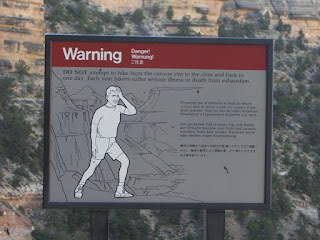
(Click on the picture to read the fine print)
Also, you have to ignore that the menu at the Phantom Ranch restaurant/store has beer and steak.
Fortunately, all three of us are good at ignoring things. Look how happy we were when we got to the South Rim:

Oh, it turns out that Phantom Ranch is 9 miles from the South Rim, so our 21 mile hike was actually 25. The beer and hamburger were awfully good, though.
The next day, we made our way back up to Cottonwood Campground. We did not have any bright ideas on this day -- our feet hurt too much.

On our final night and morning, we went into "locust" mode and ate as much of our food as we could so we would have the energy to make it up the North Rim, which is about 1000 ft higher than the South. We had a great hike and it even ended with a terrific view of the San Francisco Peaks in Flagstaff.


The weather warmed up shortly after dropping below the rim. We camped our first night in Cottonwood Camp, about 7 miles down and in. The next day, we trekked a flat 7 miles down to Bright Angel Campground at Phantom Ranch.

After lunch, we came up with the brilliant idea that "since we're here, why don't we hike up to the South Rim, too?" Bag two rims with one trip. We calculated that Phantom Ranch was 7 horizontal miles from the and only one vertical mile from the South Rim. Twenty-one miles in one day is a lot for one day, but we were getting passed by thru-hikers all day so we figured we could do it. Plus, there there is beer and hamburgers on the rim. Of course to pull off a stunt like this, you need to be good at ignoring warning signs.

(Click on the picture to read the fine print)
Also, you have to ignore that the menu at the Phantom Ranch restaurant/store has beer and steak.
Fortunately, all three of us are good at ignoring things. Look how happy we were when we got to the South Rim:

Totally worth it.
Oh, it turns out that Phantom Ranch is 9 miles from the South Rim, so our 21 mile hike was actually 25. The beer and hamburger were awfully good, though.
The next day, we made our way back up to Cottonwood Campground. We did not have any bright ideas on this day -- our feet hurt too much.

On our final night and morning, we went into "locust" mode and ate as much of our food as we could so we would have the energy to make it up the North Rim, which is about 1000 ft higher than the South. We had a great hike and it even ended with a terrific view of the San Francisco Peaks in Flagstaff.

Rim to Rim to Rim!

Tuesday, May 20, 2008
Happy Birthday Jeff - Our Ironman
Happy Birthday to our friend Jeff, who is not just faster than a speeding Yaris and stronger than a Sledgehammer -- he's made of iron:


Tuesday, April 01, 2008
Tuesday, March 25, 2008
3 Ugly Guys @ Tempe Music Festival
The 3 Ugly Guys (3UG) are playing this weekend at the Tempe Music Festival. Jen and I have gone to several 3UG shows and enjoyed them all. Our friend, Nick Rivette, is their lead guitarist and my personal Guitar Hero. They have posted a few of their songs on MySpace for your sampling pleasure.
So, if you're free this weekend or next weekend, I recommend checking 3UG out and supporting local music.
Rock on!
So, if you're free this weekend or next weekend, I recommend checking 3UG out and supporting local music.
Rock on!
Monday, March 24, 2008
Big, Cheap DIY Whiteboard
I built a 3' x 5' whiteboard for $28.80 using materials you can find at Lowe's or Home Depot. A whiteboard of this size costs $200 or more, if you can find one at all.

Materials:
This thing is sweet.
Ok, back to my architectural diagrams...

Materials:
- an 8' x 8' sheet of white panelboard, also called tileboard, cut down to size. The fine folks at Lowe's did this for me.
- some 1" x 2" wood (birch?) and L-braces to frame it
- D-ring hangers (these are nice because they affix to the back of the frame very with minimal protrusion)
- 30-lb picture hanging hardware
- some wood screws to affix the panelboard to the frame
This thing is sweet.
Ok, back to my architectural diagrams...
Thursday, March 20, 2008
Tuesday, March 04, 2008
Book Review: Collective Intelligence
Have you ever wondered how:
Oh, and Collective Intelligence reads incredibly well. I could not wait to get home and get back to it -- and when I went in to work the next morning, I usually had a new idea or two of how to improve our software. I also started implementing the most important examples in Groovy to make sure I got it.
If you are a Senior Software Engineer or "better," this is a must-read. Proper application of the algorithms in this book are a great way to simplify your system and avoid getting nickel-and-dimed to death with new ways to prioritize/categorize/slice-and-dice your domain data.
- Google comes up with its search results
- Amazon recommends you books/movies/music
- spam filters decide good from bad
Oh, and Collective Intelligence reads incredibly well. I could not wait to get home and get back to it -- and when I went in to work the next morning, I usually had a new idea or two of how to improve our software. I also started implementing the most important examples in Groovy to make sure I got it.
If you are a Senior Software Engineer or "better," this is a must-read. Proper application of the algorithms in this book are a great way to simplify your system and avoid getting nickel-and-dimed to death with new ways to prioritize/categorize/slice-and-dice your domain data.
It's not a bug...
There is some excellent surrealist (ala Magritte) programmer humor at:
http://www.photobasement.com/not-a-bug/
For those who don't get it, but want to, see the Jargon File.
Brilliant.
http://www.photobasement.com/not-a-bug/
For those who don't get it, but want to, see the Jargon File.
Brilliant.
Saturday, February 16, 2008
Book Review: Mastering Regular Expressions
I just finished the Jeffrey Friedl's Mastering Regular Expressions. My previous regexp education has been driven by the necessity to scan a log file or search or replace a snippet in a source tree -- that is, haphazard. Friedl's book really is worthy of its title and it should carry The Definitive Guide as its subtitle.
Friedl is a Regexp Master and reading this book is really an excellent way to improve your understanding of the theory, implementation, and application of regular expressions.
As a practical result of this book, I have noticed I am more confident in applying regexps in my text editors (UltraEdit and IntelliJ IDEA) for both search and replace -- particularly for "captured groups." This is useful for taking code and turning it into documentation that non-programmers can read.
Saturday, February 09, 2008
Create Fixed-Width Files Easily
If you need to create fixed-width files, you may be interested in a fixed-width recordset builder I wrote for Groovy. It lets you create a set of fixed-width records with the following sort of code:
You can get the goods from my svn repository:
You can log in with the user guest. The user does not have a password.
The Groovy website has more on the general topic of builders in Groovy.
Enjoy!
def builder = new FixedWidthRecordSetBuilder()
builder.TestData(){
  record1(){
    field1(startPosition : 0, width : 5, content : short_content)
    field2(startPosition : 5, width : 10, content : long_content)
  }
  record2(){
    field1(startPosition : 0, width : 5, content : short_content.reverse())
    field2(startPosition : 5, width : 10, content : long_content.reverse())
  }
}

builder.records.each { record ->
 println record.formattedContent  //or to a file
}
You can get the goods from my svn repository:
You can log in with the user guest. The user does not have a password.
The Groovy website has more on the general topic of builders in Groovy.
Enjoy!
Tuesday, February 05, 2008
Grails 1.0 has been released
Grails 1.0 has been released! For details, see the release notes.
Grails is a convention-based web/enterprise application development framework that lets developers write in Groovy, but use all of the great existing Java infrastructure libraries like Spring and Hibernate.
I am using Groovy and Grails wherever I can and I love it -- I'm very productive. I also love that Grails 1.0 has a fix for the bug I encountered with 1.0-RC3.
Many thanks to Graeme Rocher and the Grails team.
Monday, January 07, 2008
Book Review: Agile Development With SCRUM
There's been a lot of press in the software industry over the past few years about Agile development processes. SCRUM has been one of the most talked-about (hyped?) processes and has possibly the most ardent supporters. Ken Schwaber and Mike Beedle's 2001 book Agile Development with SCRUM (ADwS) is the definitive book on SCRUM by the guys who invented it. My conclusion:
Believe the hype.
I've been putting off this review while searching for an approach to describe just how much I enjoyed and agreed with the software development process described by ADwS. As an engineer with training in control systems, probabilities, and statistics, I really connected with the controls-based approach SCRUM uses to eliminate estimation error. As a software developer, I relish the idea of being able to work toward one set of achievable goals for a month before switching directions. As a manager of software projects, I like the idea of having something releasable to my customers every month.
If you're interested in learning more about the SCRUM software development process, I suggest reading Chapter 2 of ADwS and checking out the Control Chaos website. I'm sending these links on to my project manager now...
I also need to purchase a copy of ADwS so that I can read/review it yearly along with Peopleware and The Pragmatic Programmer.
Tuesday, January 01, 2008
Happy New Year!
Happy New Year everybody!
I wish you a year of happiness, health and jalapeño poppers.
If you're looking for some help (e.g. gentle reminding) with your New Year's resolutions, take a look at 43things.com.
I wish you a year of happiness, health and jalapeño poppers.
If you're looking for some help (e.g. gentle reminding) with your New Year's resolutions, take a look at 43things.com.
Subscribe to:
Posts (Atom)