Friday, May 29, 2009

Google Wave - The Next Big Thing?

I am super-impressed with what I have seen about Google Wave, the new collaborative communication tool that was announced this week.

Wave melds e-mail, instant messaging, document creation, and more into one coherent environment. There's plenty of feature-candy too, like:
  • document creation functionality has notion of branches and merging as well as inline comments (that can be stripped on 'publish')
  • context-aware spell-checker that can determine if you used the wrong correctly-spelled word
  • automatic translation of text from one language to another
  • the ability to split a portion of one message into its own thread within a wave; "inline replies" get their own thread

The product team did a great demo launch at Google I/O, you can watch it on YouTube:

Friday, May 22, 2009

Mediterranean Pictures

Jen, Tina, Jeff, and I put together a photobook of our trip to the Mediterranean:

Click here to view this photo book larger


We had it printed and we love it.

Wednesday, May 06, 2009

Joe the Software Engineer on Saving

My friend and colleague Joe was interviewed by the Mvelopes blog to find out how he used Mvelopes to save a bunch of money to kick the credit crack. He found Mvelopes helped him see where his money was going and helped him stick to his budget.

If you are looking for some assistance with a savings program Mvelopes may be just the ticket. There is a monthly fee, but they do have free trials.Link

Monday, February 23, 2009

Geithner's Gotta Go

President Obama,
Treasury Secretary Timothy Geithner needs to be replaced with a leader who engenders respect and can create and explain in detail an honest, fair, realistic, general-purpose plan to restore the US' financial health.

Many people were skeptical of Geithner's nomination since he is one of the key banking insiders responsible for our current financial crisis. After all, as head of the New York Fed, Geithner was the primary regulator for Citigroup and other Wall Street banks. Additionally, he ignored the danger of the unregulated OTC derivatives market which appears to be the most destructive, yet completely unaddressed, threat to our financial institutions. It seems unlikely a person so blind to the warning signs and ineffective in the past year will guide us out of this crisis.

Today's joint release is a shockingly perfect example of Geithner's ineffectiveness. The Magic Pixie Capital 'plan' whereby Treasury and the Fed sprinkle borrowed/printed capital on obviously insolvent financial institutions whenever they need it is worse than ineffective. The stock, bond, commodity, and political Markets are looking right through this thinly-veiled guarantee to 'bail at all costs.' The Markets know that Citigroup and its ilk are worth far less than zero, and the US taxpayer cannot bear their debt. US fiscal policy alone has placed us on the path of monetizing the debt (aka buy silver and gold - Asia, India, and the Middle East love these timeless monies). Adding the financial system's liabilities to the US' balance sheet risks the destruction of the dollar. Iceland and the UK have provided us a warning -- the krona is done and the pound is on its way. China's warning has been even more explicit.

The citizens of the United States are already on the hook for three black holes: AIG, Fannie Mae, and Freddie Mac. Combined, they have expressed need for $260B in the last 7 days! We do not need Citigroup, Bank of America, or any other institution. If a bank is insolvent, guarantee the deposits and cram down the capital structure until it is ready to go. If there is not enough capital, then liquidate them without creating more 'too big to fail' institutions. We need a functioning banking system and there are plenty of good banks out there -- the zombies are just getting in the way.

Former Treasury Secretary Henry Paulson's ad-hoc approach to the financial crisis could be explained away as the winddown of the Bush administration and the 'surprise' of it all -- classic Kick The Can by a guy who helped create the problems. However, now that we have been in the frying pan for more than a year no one can claim to be surprised, least of all Timothy Geithner.

Maybe it's time to pass the reins to Volcker; he is a respected leader with a track record of speaking clearly and he proved his mettle in hard times. There are many people qualified for the job, but perhaps the most important quality to obtain is courage as there is a lot of painful work that needs to be done and now is the best time to start that work. If the plan is honest and fair, the American people will do their part.

P.S. Press Secretary Gibbs should probably tone it down. Many people have had the chance to read the Homeowner Affordability and Stability Plan Executive Summary and it will bailout a significant number of reckless lenders and borrowers. We get that you need to throw another $100B at both Fannie and Freddie -- not your fault. However, marketing the Affordability Plan as something which will not bailout Sub-prime/Option-ARM/Alt-A/income-could-never-retire-the-debt borrowers and lenders is a mistake because it's provably not true. Gibbs probably doubled the turnout to the Chicago Tea Party with his response to Santelli which starts off decent enough, but then goes overboard on the sarcasm.

Wednesday, February 11, 2009

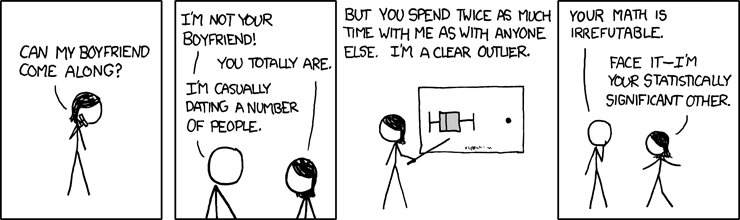
Romantic Statistics

Significant-other logic from the brilliant XKCD:


Thursday, February 05, 2009

Shutterfly is Hiring

Shutterfly is hiring!

The most immediate openings are to staff the new printing facility here in Phoenix. The three main categories of jobs are:
  • shift manager
  • maintenance manager
  • maintenance tech
Details are available on the Shutterfly jobs page.

I really like Shutterfly and recommend it. I think they are looking for folks with industrial engineering and/or supply chain experience for the shift manager positions. The maintenance folks will be responsible for printing as well as bindery tools. Shutterfly is participating in a job fair next Monday and Tuesday at the Crown Plaza Phoenix Airport location.

The jobs page doesn't list it, but if you are an Adobe Flex and Flash all-star, we would love to have you.

I will pass on your resume if you are interested in any of these jobs.

Sunday, February 01, 2009

Better than BARF

The banksters are ramping up the talk of a "bad bank" to take the losing bets of the financial system and give them to the US taxpayer. Naturally, the financial system will keep the winning bets. The Bad Asset Repository Fund is a bad idea for a lot of reasons -- the best two of which are that the US taxpayer can't afford the 3-4 trillion dollar tab and no one is going to lend it to us anyway. Forbes has more of the story on BARF.

However, something must be done. The best suggestion I have seen so far is from Karl Derringer at Market Ticker and it runs basically like this (full post):
  1. Bring the Credit Default Swap market above-board:
    • Force contracts to be backed by capital -- if there's no capital, void the contract.
    • Require all new CDS contracts to be written against a public exchange.
    • Consider prohibition of 'naked' shorting via CDSes. (I would.)
  2. Suspend trading of bank stocks for two weeks; send in the bank regulators and mark everything to market. Banks that are insolvent according to Tier Capital rules get "crammed down" and their new owners (current bondholders) decide if current management stays or goes.
  3. If a crammed downLink bank still cannot survive, the FDIC takes over the bank and handles it like the Resolution Trust Corporation of old. This is actually a self-funding bad bank model that has no/minimal asset valuation problems. The taxpayer won't be financing a give-away to the banksters.
  4. Offer the second half of the TARP to healthy banks that want it or to spin up new banks. Personally, I wouldn't mind seeing the creation of a few more P2P LendingClub-like organizations.
  5. Investigate the fraud and prosecute it vigorously (go Andrew Cuomo!). The financial system is rife with it:
    • the banks, commercial and "investment"
    • the rating agencies
    • the Fed
    • the government: Treasury, FDIC, SEC, OTS, OCC, Congress -- all of them
Derringer's plan:
  1. The total cost of this approach to the taxpayer is practically nothing -- stimulus bill rounding error not counting #4, and $350B with it included
  2. Brings transparency back to the financial markets (mark-to-market), no more 'over-the-counter' CDS contracts
  3. Punishes management and stockholders of the banks that made bad loans and decisions; gives what is left of the bad banks to its creditors -- exactly what happens to other bankrupt businesses
  4. Rewards well-managed banks for their prudence by clearing the way for them to take the bad banks' customers
  5. Serves up justice for the people responsible for this mess

Saturday, January 03, 2009

Investing for the Future

What would have happened if you had invested $1000 on the last market day of the year in the following investments, starting on Dec 31 2000?


Investment value on Dec 31, 2008:
  • Gold - $16,043.10
  • Silver - $11,446.20
  • S&P 500 - $4,370.23
  • 5-year CD - $10,573.45
  • Cash - $9,000.00
Surprising observations:
  • the S&P 500 investment lost over 56% of the principal invested
  • gold did not lose value in any year (on a year-over-year basis)
I only analyzed back to 2000 because that is when I began saving for retirement through a 401k.

This simple analysis leaves me wondering:
  • Why do 401ks (at least the ones I have seen) not provide precious metals or CDs as investment options? Why must our retirement plans always have something at risk?
  • If gold is merely a store of wealth and not a 'productive' investment, then how on earth can it be providing the best returns over a non-trivial timeframe like 8 years? How big is the credit bubble? Is the US dollar a bubble and is it popping?
Many stock market pundits are proclaiming that now is a great stock-buying opportunity. Haven't they been saying that for 8 years? Isn't the S&P 500 still overpriced historically in terms of earnings and relative to GDP? Keep in mind that financial companies accounted for something like 40% of the S&P 500's earnings in recent years and a large portion of US GDP only exists in a credit bubble. That trend will not hold in 2009. This means stock market prices must decline to keep pace with declining earnings and GDP.

The S&P 500 closed out 2008 at 903; according to my hand-waving (aka analysis) the S&P 500 needs to go below 650 to reach valuations similar to the '74, '78, and '80 recessions. Yet having the S&P touch 650, 600, or even 550 does not mean that it is a good time to buy stocks. Consider the stagflationary period from Aug 11, 1972 to Aug 6 1982; the S&P 500 went from 119 to 103. I haven't done the math on what you'd have left after adjusting for inflationary losses after the 15% nominal loss, but it's not pretty.

It seems like saving money for the future should be a simple matter as long as one has the means and the willpower, and yet it isn't. Why is that?

Pricing data was obtained from:
My Investment Analysis is available as a Google Spreadsheet. I am most interested in any and all errors you find.

Disclosures:
  • Long gold and silver
  • Almost long energy commodities - will buy when deflation halts
  • Short US stocks
  • Short US real estate - residential losses halfway (changed from 'mostly') done, commercial just getting warmed up
  • Short US dollar except vs Euro

Thursday, January 01, 2009

Happy New Year!

Happy New Year 2009, everybody!

Jen and I wish you a healthy and happy one. Jojo wishes you would just pet her without looking at her.

Monday, December 15, 2008

Great Customer Service from REI

In 2006, Jen and I bought lightweight, weatherproof 'Taku' jackets from REI. I think we got them on clearance -- mine was around $80, Jen's $65, well under the $150+ jackets in this category usually retail for. Anyway, sometime in 2007, we received recall notices from REI saying that there was a defective zipper and to bring the jackets in for repair. Since our jackets were doing fine, we ignored the notices and just kept on using the jackets. Two months ago, the zipper problem struck both jackets.

Finally, it got cold enough that running with the pit-vent zipper stuck open was unacceptable to me. I took the jackets into REI sans receipt. The REI folks looked up our separately-purchased jackets via our REI membership ids. The recall period had passed, but the assistant manager offered an exchange credit. It soon became clear to her that what I really wanted was a functioning jacket (and not enough store credit to only replace one jacket), so she offered to have the zippers replaced free-of-charge. I picked up the repaired jackets today and they look good. I'll try mine out on tomorrow morning's cold, wet run with Jojo -- expecting all sunshine and rainbows from the Taku.

Thanks REI, that's great customer service!

Sometimes I wonder if paying a little more is worth being able to choose from a wide selection of high-quality products and to be assisted by knowledgeable and passionate employees who are empowered to delight their customers. Today and most days, I definitely think it is worth it.

Thursday, November 27, 2008

Happy Thanksgiving!

Happy Thanksgiving, everyone!

I am thankful for...
  • my bubbas, Jen and JoJo
  • our families
  • our jobs
  • our house
  • our friends
  • plentiful food
  • the Constitution and the Bill of Rights
  • the people who protect our liberty and safety
  • the Internet and Free and Open Source Software
  • my physical fitness and the ability to run, hike, and play fetch
  • the ability and the right to read and write whatever I want
  • opportunity

Wednesday, November 26, 2008

New Kuenzli Picture Site

Jen and I have created a new 'Kuenzli Family' picture website via Shutterfly's Share service. I've uploaded a bunch of our recent pictures - trips to San Francisco and Santa Fe as well as pictures of Bandit and my niece Jacquelyn's baptism.

Monday, November 17, 2008

Crash Course

A friend pointed me to Crash Course today. Crash Course is a thoughtful and easy-to-understand explanation of how the US economy got into the current mess and makes some conjectures as to where it is going. (nb: thoughtful and easy-to-understand does not mean correct, but the analysis is worth consideration)

The author, Chris Martenson, has a pretty interesting background and communication style that resonates with my engineering brain.

I recommend going through the entire online course, which is free, even though it will take a few hours. I'm fairly addicted to economic and financial news and books and I was pleasantly surprised at how often Martenson clearly explained something that I previously had trouble understanding (like how the Fed creates money and how much our financial system and economy depend on growth). Martenson also draws links between energy and the money supply that I had not considered previously but I find intriguing.

The most useful part of the course may be the final chapter where Martenson shows how to think through and prepare for the various scenarios yourself via a Failure Mode Effects Analysis-like process. It's time to break out the spreadsheet.

Wednesday, November 05, 2008

Shilling for Shutterfly

My super-fantastic employer, Shutterfly, has offers all kinds of thoughtful, personal cards, gifts, and photo prints -- and a lot of it's on sale. We just received an order of thank you notes and they've been customized with our favorite picture from our trip to Sante Fe. Jen's given them her seal of approval.

Shutterfly has holiday cards, picture printing, photo books (a coffee-table quality picture 'scrapbook'), and lots more. The design tools are pretty sweet too. I didn't even think the stuff we're doing was possible in a web browser.

America Voted!

It looks like an awesome ~65.7% of eligible voters voted in the 2008 presidential election. This is the highest turnout since 1908 and bests the previous modern record of 63.8% observed in the 1960 Kennedy-Nixon contest.

Friday, October 24, 2008

Loans that Change Lives - Kiva.org

Loans that Change Lives is the catchphrase of Kiva, a person-to-person micro-lending website. Ok, so what does that mean?

It means you can easily fund entrepreneurs in the developing world. You peruse the list of potential borrowers and fund a portion ($25 or $50, typically) of a $500-$1000 loan. The loan is paid back in monthly installments and you get updates about how the entrepreneur is doing.

I've made 8 loans so far and no defaults yet. It will be interesting to see if/how the credit crunch in the developed world impacts the developing world. The strength of the dollar is going to make it difficult for borrowers to earn enough in their local currency to stay current on the (unsecured) loan. This is the key problem presented by deflation -- asset prices drop but loan obligations do not.

Sunday, October 19, 2008

It's Bonus Time for Wall Street

It looks like the Wall Street Bailout of 2008 is working wonderfully. It is working so well, in fact, that Wall Street executives will take home approximately $70 Billion dollars in bonuses for their 'performance' in 2008.

WTF.

Saturday, October 04, 2008

Vote in '08! - II

The Arizona voter registration deadline is Monday, so get registered or request your early ballot if you haven't already.

For those looking for an objective view of the candidates, I've come across two more resources:
  • PolitiFact's Truth-o-Meter
  • Peter Norvig's Presidential FAQ. Peter is a leader in Artificial Intelligence, and is one of the folks responsible for ensuring Google returns good results.
Casting an informed ballot is cool.

Be cool.

Tuesday, September 30, 2008

How Your Representatives Voted on the Bailout

You can check how your representatives voted on The Bailout, aka House Vote 674.

Arizona's four Republican and four Democrat representatives all voted No.

Thanks -- that took guts.

Monday, September 29, 2008

The Bailout is Dead! Long Live the Bailout!

The Bailout is Dead!
The 'revised' bailout bill failed. For 99% of citizens this is a good thing - the bailout was only going to treat the symptoms on Wall Street while ignoring the real problem - a bunch of Americans with too much debt. Two weeks of negotiation merely managed to turn a 3-page blank check into a 110-page blank check. Kudos to the House Republicans and Democrats who voted no. There are plenty of options that have a historically-proven chance of succeeding, this is not one of them.

I like Nouriel Roubini's HOME plan, though a Swedish-style nationalization would probably work too. In any event, the taxpayer should be guaranteed equity in the institution being bailed out. Astute observers will note this is exactly what Warren Buffett demanded when the Oracle of Omaha invested capital in Goldman Sachs.

Long Live the Bailout!
Bloomberg is reporting that the Fed has decided not to wait that the Fed has decided not to wait for our elected representatives to bailout the finance industry. They are going to 'inject' (aka print) $630,000,000,000 into the global financial system starting...now. I don't know why they'd shovel $630B through the backdoor instead of $700B. Maybe the willful violation of Congress' authority would be noticed?

Ben Bernanke is going to use the power of the press to defeat the nation's debt - by making the dollar worthless.

This kind of approach tends to piss off your lenders, like China, who may decide to stop lending. Let's hope other lenders do not follow suit because the US will default on its debt if they do.

What can/should you do?
  1. Pay off all credit-card debt. Borrowed money is about to get expensive.
  2. Re-finance all adjustable rate debt to fixed rates. When your debt is at a fixed rate, inflation works to erase it.
  3. Sell large assets denominated in USD and move any cash savings to (currently) solid currencies: Canadian/Australian/Hong Kong dollars, the Euro is pretty good except the Euro-zone is about to have its own subprime meltdown. You can do this at E*Trade; it's easy. Remember, just as inflation eats away at your debt, it eats away at your savings.
  4. Invest in commodity indices like energy (RJN) and metals (RJZ). The nice thing about investing in energy commodities is that it will offset what you are paying at the pump. Energy commodities are also priced in dollars, so they will increase in price with inflation (as will gas prices).
More Economics Reading - I promise it's not dismal!
If you want to know more, I highly recommend the following:

Economist blogs:
Books: